Thursday, April 19, 2007

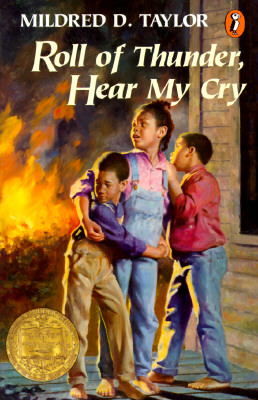
Mildred D. Taylor's Roll of Thunder, Hear my Cry


Begin: 04/15/07
End: 04/18/07
Quality: Ten out of Ten
Reason: Newbry.
Genre: Children's Literature. Fiction. African-American Literature.
Original Language: English.
Date of Publication: 1976.
Fog Index: 7.0/ 91% are harder.
Flesch Index: 76.9/92% are harder.
Flesch-Kincaid Index: 5.3/91% are harder.
Complex Words: 6%/91% have more.
Number: Twice?
Synopsis: This is the story of a black family living in deppression-era Mississipi and struggling with poverty and racism. The narrator, nine year old cassie logan, comes to discover a lot about the world she lives in during the course of this story, which takes place over about a year.
Thoughts:

Brilliant. I forget exactly how much I fucking loved this story. It's almost painful how poigant and moving it is. How much you grow to love and adore these characters. Cassie, Little Man, Big Ma, Papa, Mama, Mr. Morrison (who i always imagine as somehow related to Toni Morrison for some reason.)

I am not sure what it is about African American Literature that has such an appeal to me. Is it the same thing which draws me to African American music? Perhaps. Something to be looked into.

The story flows quite quickly. It's almost a three hundred page book but you get so connected to the characters and so concerned about what is going to happen that it just flies by and then you long for more.

Their is just something so powerful about this close knit family doing anything they can to not only hang unto their land and their dignity but also to try and improve things for their neighbors and friends.

I am at a loss to talk about it right now. I am not sure why so I am going to leave off here. (I guess my literature degree really is good for nothing)

"You see that fig tree over yonder, Cassie? Them other trees all around...that oak and walnut, they're a lot bigger and they take up more room and give so much shade they almost overshadow that little ole fig. But that fig's got roots that run deep, and it belongs in that yard as much as that oak and walnut. It keeps on blooming, bearing good fruit year after year, knowing all the time it'll never get as big as them other trees. Just keeps on growing and doing what it gotta do. It don't give up. It give up, it'll die. There's a lesson to be learned from that little tree, Cassie girl,'cause we're like it. We keep doing what we gotta, and we don't give up. We can't"
(206)

Wednesday, April 18, 2007

Dante Alighieri's Paradiso


Dante Alighieri's Paradiso
Begin: 04/09/07
End: 04/18/07
Quality: Seven Out of Ten.
Reason: Reading Plan.
Genre: Classics. Epic Poetry. Italian Literature.
Original Language: Italian.
Date of Publication: 1314.
Fog Index: 11.5/63% are harder.
Flesch Index: 64.4/73% are harder.
Flesch-Kincaid Index: 8.8/66% are harder.
Complex Words: 10%/71% have more complex words.
Number: Once?
Synopsis: Beatrice gives Dante a tour of the Heavens.
Thoughts:

I never really have a problem with getting through the Inferno. Purgatory is a little tougher but I can do it but Paradiso is always insanely tough for me to complete. I like hearing the stories of the sinners but paradiso is just chocked full of far too much medieval theology and cosmology and it makes it extremely tough for me to get through as a result.

I am not even sure what to make of it. I really understood the set-up of hell and purgatory but getting my mind around ptomleic astronomy was extremely difficult. The spheres of the heavens were just not as simple to imagine as the circle of hell or the terraces of purgatory. And Dante and Beatrice just kept on talking some much damn theology.

I still gave it a seven because it is one of the classics of western literature but maybe next time I will stop reading as soon as Dante get's to the top of purgatory cause I just can't make it into paradiso.

Sunday, April 15, 2007


People of Paper by Salvador
Begin: 04/09/07
End: 04/13/07
Quality: Nine Out of Ten.
Reason:. Book Club
Genre: Magical Realism. Metafiction. Fiction.
Original Language: English.
Date of Publication: 2006.
Fog Index: N/A
Flesch Index: N/A
Flesch-Kincaid Index: N/A
Complex Words: N/A
Number: Never.
Synopsis: I am not quite sure how I would be able to explain this story, to somehow create a nice and little synopsis of this rather complicated and interconnected work. The main protagonist in this story seems to be centered on Fernando de la Fe and his daughter, Merced. They move from Mexico to California. Once ensconced in El Monte, de la Fe gathers the local carnation picker gang to wage war on Saturn. That is the main story but it is a lot more complicated than that. A score of characters gets involved as well as the author himself becoming a main participant in the drama.


Thoughts: Hot Damn! This was a great fucking book. It was a little slow in the beginning but it picked up and got me so totally engrossed in it. The richness of the prose, the implicit sadness weaving it’s way throughout the story, the characters who become so real, who become like old friends. This was a great fucking book.

I just want to touch on a few things.

The style of the novel was so powerful. It was amazing to me that Plascencia was able to successfully blending magical realism with metafiction and still have such a odd features to the text of the story itself and still make it work.

I also love the way that sadness weaved its way in and out of the story. You could almost taste the texture of the sadness. It was unbelievably rich.

Anyway. I’m tired. I want to talk more about this work, but I’m just beat so here are a few quotes. I also copied some definitions of the genres of magical realism and metafiction down at the bottom.

“Confirming the theory that equilibrium is always upset by wax and first love.” (44)

Merced de Papel never came to believe in the permanence of love. To her the idea of a romance enduring even a season was a baffling absurdity. “It’s something that burns and disappears into ash.” This is what she said as she swept the floor, pushing the flakes of newsprint into the dustpan.
Any combustion, regardless of its intensity, must ultimately extinguish. Some fires last only for the strike of the flint, while others burn for millions of years before the day of their supernova arrives, leaving only embers and cold debris. And so love need not burn forever, just long enough for paper to smolder. (168)

Ten years later, Charles sold her to a railcar zoo but kept her litter. While sleeping and dreaming of jungle theme parks and safari hats, the three cubs mauled his feet and arms. He survived, and it was he who told me that it is not elephants that never forget, but those we betray. Those we hurt. Species that pass down their memories through generations, transferring their bitterness and resentment to their kin, never able to forgive, their arms always cocked with lettuce in hand. Unable to excuse a change of address or wardrobe. Telling their children and grandchildren that I am their sellout whore. (214)

Magical Realism. : Magic realism (or magical realism) is an artistic genre in which magical elements appear in an otherwise realistic setting.
Metafiction: It is the term given to fictional writing which self-consciously and systematically draws attention to its status as an artifact in order to pose questions about the relationship between fiction and reality

Monday, April 9, 2007

Matthew Rettenmund's Boy Culture


Matthew Rettenmund’s Boy Culture
Begin: 04/04/07
End: 04/08/07
Quality: Five Out of Ten.
Reason:. Random.
Genre: Confessional. Fiction. Queer Theory.
Original Language: English.
Date of Publication: 1995.
Fog Index: 9.4/74% are harder.
Flesch Index: 65.5/76% are harder.
Flesch-Kincaid Index: 7.7/72% are harder.
Complex Words: 9%/75% have more complex words.
Number: Never.

First, I have a confession about this book. I totally bought it because Jesse Archer is going to be in the movie version and I am a little into him right now.
He’s half my crush and half my idol right now. Hey! I’m allowed to be a crazy girl sometimes too!

I really loved this book in the beginning. I mean, I was eating it up. I really connected to the character of X. His viewpoint was startling close to mine.
Cynical, funny, witty, perceptive. It’s what I feel that I am. I was a little concerned that I have such a deep connection with whores and strippers. The story progressed and I felt less and less of that connection as his character developed and grew.

It was a realistic arc for his character but I was still disappointed. I felt that it started out fresh and honest and enlivening to me but ended up like every other prostitute story. I didn’t want Pretty Women with some fags thrown in!

I also had an aversion to the sex scenes. I read a lot of erotica, a lot. I live for it.
The sex though wasn’t that hot to me. I had a hard time believing some of it. I mean full anal at 13? Come on now? My willing suspension of disbelief isn’t that strong. Or maybe that does happen and I just missed out. I really don’t know.
And can I just mention how disgusting and vile barebacking is to my mind? Can we completly disregard the looming health crisis on the last three, count them, three decades. I realize it's just a story and it got across a level of trust but fuck that! Wrap it up, mother fuckers!!!

The sex index in the back is pretty funny.

It was also extremely quotable. Hence the page and half of quotes I culled from it. Enjoy. I’m on to People with Paper.

“In that moment of utter surrender to adulation, to desiring perfect, vicarious, romantic deification, I understood what it is to be a gay man. It’s all about intensity.” (17)

“Sex is really so unattractive. It’s all so ugly, I can hardly discuss it.” (19)

“I felt for him, and I thought that to make him feel better, I should feel him up. He’d feel much better very soon, and younger and less useless….if only for an hour or so. But isn’t that always the way? What do you think sleeping around is all about anyway?” (27)

“Lust works in mysterious ways...Attraction is chance.” (30)

“Actually, “manhood” is a pretty canny term. I still call it a dick or a dick or a prick, but “manhood” comes much closer to conveying the complex array of emotions that find their gathering point in the penis, and that compel such foolhardy souls as I to worship that member in a way that embarrasses us in our more rational, guarded moments.” (33)

“Coming isn’t the decisive factor in what you find pleasurable.” (37)

“Anal sex is so abstract. It’s not at all like any novice would ever be able to imagine it. It’s not necessarily messy or bloody (please!), and more than anything, it doesn’t have to hurt one bit. If there is a single part of your being that resents the intrustion, it will hurt proportionally. If you are completely physically and mentally and emotionally prepared, it’s blissfully proportionately. It’s a delicious severance from yourself, a deliverance from that feeling of abdominal guardedness. The tightness goes away (though hopefully not completely) and you are left basking in utterly defenseless relaxation. What could be sexier? Sex isn’t about intensity of physical stimulation, but about degree of abandon. The extent to which you can let yourself go.” (44)

“’You can’t have your cake and eat it, too.”
“Why not? Whoever made up that rule was born bitter” (121)

“I don’t understand why guys are so willing to fuck around. It seems to devalue your body to pass it around so freely, you know. I mean, I have a lot of sex, but none of it unless I’m being paid for it.” (125)

“Everyone lies, but you only lie about certain things to certain people. You don’t lie about everything to a person. Unless, of course, it’s a person of no consequence.” (161)

Saturday, April 7, 2007

Dante Alighieri's Purgatorio


Begin: 04/01/07
End: 04/06/07
Quality: Nine Out of Ten.
Reason:. Reading Plan.
Genre: Classics. Epic Poetry. Italian Literature
Original Language: Italian.
Date of Publication: 1314.
Fog Index: 11.5/63% are harder.
Flesch Index: 64.4/73% are harder.
Flesch-Kincaid Index: 8.8/66% are harder.
Complex Words: 10%/71% have more complex words.
Number: Once?

I always have an easier time getting through the Inferno than the other two sections of the Divine Comedy. It does help that because of my previous readings, I have a good sense of the structure of the three areas and pre-knowledge.

As when I was reading the Inferno, I was constantly amazed at how Dante seems to have two idols, Christianity and the Roman Republic. Cato guards the approach to Purgatory. (This, by the way, is a giant mountain directly opposite of Jerusalem and the only land on the southern hemisphere) Why are so many pagans stuck in Limbo, including Virgil, when Cato seems to have taken up a post of authority? Why does Cato get off so easy when Brutus is in Satan’s mouth?

Again, medieval theology is so depressing. The terraces of Purgatory, I guess, are a little better than Hell since you have a chance to get out to paradise but still. You have your eyelids sewed shut? What kind of sick masochist thinks that shit up?

I have to say though that I was happy that some of my fellow faggots got to be in purgatory. I was a little worried that we were all stuck in Seventh Circle of Hell, but I guess if you suck dick and love jesus, you get stuck in the seventh terrace of purgatory. Well, that’s a relief! If I start loving Jesus, I’m set!!

I was thinking that when Dante and Beatrice met, it was going to be glorious and loving, ect. Wow. She tore him a new one, huh?

Anyway. Here’s some quotes.

“The world indeed has been stripped utterly/of every virtue; as you said to me, /it cloaks-and is cloaked by-perversity.” (58-59/Canto XVI)

“Brother,/the world is blind, and you come from the world,/You living one continue to assign/to heaven every cause, as if it were/the necessary source of every motion./If this were so, then your free will would be/destroyed, and there would be no equity/in joy for doing good, in grief for evil./The heavens set your appetites in motion-/not all your appetites, but even if/that were the case, you have received both light/on good and evil, and free will, which though/it struggle in its first wars with the heavens,/then conquers all,if it has been well nurtured./On greater power and a better nature/you, who are free, depend; that Force engenders/the mind in you, outside the heavens’ sway./Thus, if the present world has gone astray/in you is the cause, in your it’s to be sought;” (65-83. Canto XVI)

o humankind, born for the upward flight,Why are you drive back by wind so slighy?” (95-96, Canto XII)

Wednesday, April 4, 2007

John Millington Synge's The Playboy of the Western World


John Millington Synge's The Playboy of the Western World


Begin: 04/03/07
End: 04/03/07
Quality: Two Out of Ten.
Reason:. Modern Drama
Genre: Drama. Irish Literature.
Original Language: English.
Date of Publication: 1907
Fog Index: 7.6/88% are harder.
Flesch Index: 77.8/93% are harder.
Flesch-Kincaid Index: 6.4/84% are harder.
Complex Words: 3%/98% have more complex words.
Number: Never.


Plotline: Okay. This one is pretty weird. A man named Christy enters this small Irish town and tells a group of people that he killed his father. This makes his something of a town hero with a number of the women wanting to marry him. His father wanders into town a few days later and


his lie is discovered. He then attempts to murder his father to regain the love and respect of the town and more importantly, Pegeen. The town people though bind him up and prepare to hang him for murdering his father. His father stumbles unto this scene and rescues him. Pegeen them laments..."Oh my grief, I've lost him surely. I've lost the only Playboy of the Western World."


Thoughts:

I really did not like this play. It was weird and stupid and I could really give a shit about the characters. I don't even know what to say about this play. Err. I want the last fucking two hours back!!

Monday, April 2, 2007

Luigi Pirandello's Six Characters in Search of an Author.


Luigi Pirandello’s Six Characters in Search of an Author

Begin: 04/01/07

End: 04/02/07

Quality: Ten Out of Ten.

Reason:. Modern Drama

Genre: Drama. Italian Literature

Original Language: Italian.

Date of Publication: 1922

Fog Index: 9.3/75% are harder.

Flesch Index: 71.7/85% are harder.

Flesch-Kincaid Index: 6.7/78% are harder.

Complex Words: 9%/73% have more complex words.

Number: Once?

Storyline: A theater group is doing dress rehearsal of Pirandello’s “Mixing it up” when they are interrupted by a group of characters in search of their author. The characters, a ragtag family, then proceed to explain their story to the very confused theater manager and theater group.


Wow. Damn good. This fucking Modern Drama anthology continues to blow me away. I might have to take a gander at this book on a regular basis. The sheer richness of some of these plays is unbelievably. And the dialogue here. The sheer absurdity of the play. I loved it.

I just love the fact that Pirandello plays with so many concepts in this play. Reality, creativity, the connection between art and reality, truth, illusion. It’s all here in this play.

A couple things to talk about in this one.

First of all, I simply loved the absolute absurdity in the play. The idea that a group of characters would invade a theater looking for their author is brilliant. I mean brilliant. How did Pirandello come up with that idea? And not only did they invade the theater, they are not docile but combative and bombastic. The “real people” in this play completely fade into the background except perhaps the manager and even he is a pale shade in comparison with the characters.

The philosophy in this play is ever present, which I certainly enjoyed. The father is a veritable walking bombastic sophist. He is constantly spouting things. He is probably the central character in this play and drives the action with his constant soap box. The play is really just about the Father, the step-daughter and the manager. Everyone else fades into the background.

I also loved the fact that reality is viewed not as something solid and substantial but something completely impartial and based on the individual. (Isn’t that Heisenberg’s law or something like that) We have that scene where the father and the step-daughter are talking about when they first met up at the brothel of sorts. (Step-Daughter:“Almost in time!” Father: “No, in time, in time!”)
Okay; I guess that’s it for now. Very good play. Read it. Love it! Oh, and lot’s of quotes. It’s one of those plays where I want to underline everything,

“Oh, sir, you know well that life is full of infinite absurdities, which, strangely enough, do not even need to appear plausible since they are true.” Father, Act I.

“In the sense, that is, that the author who created us alive no longer wished, or was no longer able, materially to put us into a work of art. And this was a real crime, sir; because he who has had the lock to be born a character can laugh even at death. He cannot die. The man, the writer, the instrument of the creation will die, but his creation does not die. And to live for ever, it does not need to have extraordinary gifts or to be able to work wonders. Who was Sancho Panza? WQho was Don Abbondio? Yet they live eternally because- live germs as they were- they had the fortune to find a fecundating matrix, a fantasy which could raise and nourish them: make them live for ever!.” Father, Act I.

“But you don’t see that the whole trouble lies here. In words, words. Each one of us has within him a whole world of things, each man of us his own special world. And how can we ever come to an understanding if I put in the words I utter the sense and value of things as I see them; while you who listen to me must inevitably translate them according to the conception of things each one of you has within himself. We think we understand each other, but we never really do. Look here! This woman (indicating the mother) takes all my pity for her as a specially ferocious form of cruelty.” (Father, Act I.

“For each one of us has his own reality to be respected before God, even when it is harmful to one’s very self.” (Father, Act I)

“Excuse me, all of you! Why are you so anxious to destroy in the name of a vulgar, commonplace sense of truth, this reality which comes to birth attracted and formed by the magic of the stage itself, which has indeed more right to live here than you, since it is much truer than you- if you don’t mind my saying so?” Father, Act II)

“Louder? Louder? What are you talking about? These aren’t matters which can be shouted at the top of one’s voice. If I have spoken them out loud, it was to shame him and have my revenge. But for Madame, it’s quite a different matter.” (Step-Daughter, Act II)